Earlier this month we had our first Honeycomb all-hands offsite in three years … our first one since February of 2020, before the plague. It was wonderful and glorious and silly and energizing and so, so SO much fun. It was a potent reminder of the reality that no virtual activity can compare with the energy of being physically present with people you care about.
I was talking with Paul Biggar last month, telling him about all the things we were doing both to create a safe environment and to ease the pangs of re-entry for a bunch of people who haven’t done this in years. Paul observed that it seemed like most companies are either 1) not gathering at all or 2) barreling forward as though COVID didn’t exist, and that there aren’t many stories about groups assembling safely.
So I said I would write one, if we pulled it off. And now that it’s been long enough that we can confidently say nobody came down with COVID at our offsite, here it is.
Offsites: luxury or necessity?
Honeycomb has always been proud to be a distributed company, even before the plague hit. It’s part of our belief system that this is just a better way of doing business.
But being distributed doesn’t mean that in-person connection doesn’t matter. It matters even more when you are all remote most of the time.
Getting together in human meatspace is expensive, it’s annoying, it’s awkward and uncomfortable and inconvenient … and it is necessary. It’s not optional or a “nice-to-have,” it is a ✨critical ingredient✨ of the recipe that makes high-performing distributed teams work. Spending time together face to face is the yeast in our bread, the bitters in our Old Fashioneds.
By the end of 2022, it had become clear that we are stuck with COVID for the long-haul. It was long past time to gather and get to know each other in person. But if we were going to do it, we had to do our best to mitigate the risks and adapt to the world we live in now. What precautions to take? Where to even start?
When and where, and why??
COVID concerns were part of the planning from day one. There were several constraints where to hold the event, which we immediately dubbed “Swarm” (of course). 🙃
- Moderate weather. We wanted to be able to let people congregate outdoors as much as possible, as an additional insurance policy for the extra-anxious.
- “Centrally located” was the original goal, but most of the country is just too cold in February. We settled for a destination that everyone could fly to direct.
- Legal safety. We needed to go to a state w/ here all of our employees felt safe, not targeted by various legal jurisdictions.
- We did NOT care about glamorous locations. We knew we were going to spend our time at the hotel, focused on each other, not the locale.
In the end we chose Los Angeles — the the oh-so-glamorous LAX Airport Marriott, to be precise. 🌴🐠\\🍹
We originally scheduled the event for mid-January, to kick off the new year, but ended up witthlizadelaying five weeks into 2023 in case there was a wave of post-holiday COVID infections.
Preparing for the event
Our COVID safety plans are designed to maximize attendance, give people enough information to properly manage their own risk, and provide an extra-safe outdoor alternative for as many activities as possible.
We tapped Liz Fong-Jones to take point on COVID policy. (As a globe-trotting extrovert who goes to lots of events, she is our resident expert.) Having one czar in charge of policy turned out to be great; she didn’t have to ask permission from anyone or get consensus from a committee to update policies and make requests on the spot.
Leading into the event, our plans and preparations included:
- Adjacent outdoors space.
We looked for a venue with extra capacity (plenty of space for social distancing and proper airflow) and a large outdoor area — covered, heated space for people to eat and socialize, even if it was rainy or cold.
- On site testing for everyone.
Everyone was given a rapid nucleic test on checking in, and asked to take onesubsequently every 48 hours.- Testing was mandatory for everyone, including vendors, guests, and visiting dignitaries.
- Positive first-line tests should confirmatory test with a PCR or second nucleic test and isolate until a negative comes back.
- If anyone confirms positive, their instructions are to stay in their room until they test negative. Honeycomb pays for hotel and rebooking.
- Carbon dioxide monitors.
Every conference room was supposed be set up with a mounted CO2 monitor where people can see it. (Carbon dioxide monitors are a good proxy measurement for air circulation and thus transmission risk.) We said, “if the number is above 650, masks will be required in the room”, but this didn’t quite play out (see “Retro” section). - Social distancing.
We had stickers for badges, color coded by the traffic light system. (This was for individuals to exercise control based on risk tolerance, not a universal rule):- Red — please keep your distance
- Yellow — please ask before physical touch
- Green — I’m comfortable with talking and physical touch
- Masks.
Masks were available throughout the event, but not required. People were welcome to wear their own masks regardless, of course, and everyone kept one in their pocket, so they could put it on if anyone asked. (This happened a few times in my vicinity, and everybody cheerfully complied.)- We booked a shuttle to haul everyone into LA for dinner, and masks
 were required on the shuttle. People were also told to call an uber/lyft if they felt uncomfortable with the shuttle.
- We booked a shuttle to haul everyone into LA for dinner, and masks
- Outdoor seating at restaurants.
One of our most popular sessions was “small group dinners”, where we sent people out to LA restaurants in small cross-functional groups of 8 people (including at least one member of senior leadership per group). People could request an outdoor group. - If a new variant or outbreak emerged…
We wouldn’t be able to call the event off or reschedule without forfeiting the entire cost. Our contingency plan was to move the entire event outdoors to the pool area, if necessary.
Pacing ourselves: naps and snacks and breaks
We knew this trip was going to be intense and overwhelming for many if not most of us — even more so than most company offsites. Many people hadn’t traveled or spent time in large groups since the pandemic, all of us are used to working solo from home. Only a tenth of us (18 of 180) were working at Honeycomb in February of 2020, at our last offsite. So mental health and social overload were just as important to consider.
We told people, repeatedly:
Take care of yourselves. Do what you need to do to be fully present while you’re here, rather than here 100% of the time.
We scheduled only three sessions per day, plus lunch and dinner. We neither started very early or scheduled things very late. We left lots of padding in between sessions for snacks and naps and breaks.
We set aside a “Recharge Room” with doors that closed, with nail polish, coloring books and markers, and board games. We set aside cubbies with signs marked “Introvert Corners — no talking please!”, and stocked them up with USB hubs and charging cables, so you could recharge your devices while recharging your soul (lol).
In retrospect
Over 86% of the company came (!!!) and we had a riotously good time — way, way more than I think any of us even expected or hoped to have. It was a memorable, sparkly reminder of the incomparable magic of what it’s like being together with people you care about.
We ran a survey afterwards. 50% of respondents said they felt safe, but their standards are low; 48% said they felt safe due to the testing, masking, and reminders; 8% said they felt safe because they spent as much time as possible outdoors. 10% (11 people, out of 109 responding) said they “did not feel very safe.”
However, I would note that 5 of those 11 people didn’t actually attend Swarm. And one person pointed out afterwards that you had to choose “I did not feel very safe” if you wanted to enter any feedback at all about safety, so it was possible if not probable that some people would have chosen another option if they could.

I think we did pretty well. However, things can always be better!
What worked well:
- Outdoor spaces for eating, temperate climate, extra-spacious rooms for circulatory purposes.
- The rapid-nucleic tests we used were made by Lucira. (Liz says: “The tests were far more reliable than we thought they’d be — the brand has a reputation for false positives but we saw none, and only 3 invalid tests out of several hundred performed.”)
- Testing. We were hyper-diligent about testing. We actually ran out of tests on Wednesday, despite provisioning two for each attendee and a bunch of extras, and had to emergency lift in more, which is a great sign.
- Taking a layered approach to COVID safety. Not relying on any single prevention method meant that if one didn’t work well, we still had a safety net.
- Having a knowledgeable COVID czar.
- The Recharge Room with nail polish, art supplies and games worked really well, although designating other areas as “Quiet Zones” was ineffective and unnecessary.
What we can improve on:
- The 30-60 minute breaks sprinkled throughout the day were well-intentioned, but ineffective. Everybody was fucking wiped by late afternoon. Next time, I would replace all those breaks with one solid “Nap Break” from 4-6pm.
- I think it’s important to acknowledge that we were all going to be flattened
 no matter what though. We aren’t used to this! It is HARD to leave the party to take care of yourself!
- I think it’s important to acknowledge that we were all going to be flattened
- We should have a team of COVID safety marshals, in addition to the Code of Conduct team.
- Next time we will ask people to submit their COVID test results — even if it’s just dropping a pic in a slack channel. Trust but verify.
- The CO2 monitors were confusing. They were hard to find, and most of them got installed in the wrong place. Also, the 650 ppm rule would have essentially meant everyone had to wear a mask in any closed room, which was not the goal. Our error here was not in failing to stick to the 650 ppm rule, but in making a rule we couldn’t keep.
- Next year, we will be explicit about the fact that CO2 monitors are for informational purposes, so individuals can factor it into their own masking choices and/or decide whether to move outside.
- Next year we will also emphasize that it is okay to ask the people around you to mask up so you can participate.
- If you aren’t comfortable asking those around you to put on a mask, you can DM a safety marshal who will ask on your behalf.
- One session in particular had external facilitators come in and roam around the (closed) rooms shouting stuff. They tested clear for COVID, but in retrospect I really wish we had asked them to mask up, as it generated a lot of anxiety. This was our biggest covid safety lapse, in my opinion.
Offsites are necessary. Human connection feeds your soul.
What I learned from this event is just how much we were all craving connection. I was a firm believer in how much in-person connection matters to start with, and it still blew me away just how special, how irreplaceably precious the experience was. There is no possible way we could have made the kind of connections, learned the same lessons, and formed the kind of bonds we did if we had tried to do this as a remote event. If anything, it just made me even more intent on creating an event safe enough that everyone can join.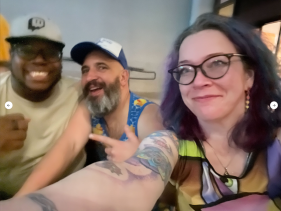
On the last night we had a party, with karaoke and a dress theme: “Wear something you wouldn’t wear to work.” By that point, it enough intimacy had been established that people seemed to feel safe letting their inner freak flag fly a bit, and it was just fucking incredible getting a glimpse into everybody’s inner selves and stories.
It seemed like others felt the same way, too. In the anonymous post-event survey, 100% of attendees said it was valuable to them. Representative feedback:
“I didn’t know how much I needed this, and I can’t wait for next year.”
Reintroducing a practice of spending time together is not only possible, I feel like we were able to do it in ways that adapt to the realities of the world we live in today.
That matters. I know I’ve said this like five times now, but for a distributed company, gathering together in person isn’t a nice-to-have, it is an absolute necessity. After meeting all of my coworkers, I feel this more strongly than ever. 💜🐝
P.S. None of us got COVID in the wake of our offsite. A handful of us did, however, manage to catch a common cold. 🦠
 approval. The early years of professional life are a similar blend of hard work, leveling up and basic skills acquisition. (They got Molly hopped on the leveling treadmill before she even had a chance to become a real adult, in other words. 😍)
 like a hamster wheel, where every single quarter you were expected to go go go go go, do more do more, scrape up ever more of your mortal soul to pour in more than you could last quarter — and the quarter before that, and before that, in ever-escalating intensity.
 structures are hierarchical and absolute (like flipping burgers at McDonalds, or factory line work). There are even software companies still trying to make it work in command-and-control mode, to whom engineers are interchangeable monkeys that ship story points and close JIRA tasks.
 And if you are sick of doing something or being treated a certain way, chances are everyone else will hate it, too. Who wants to work at a company where all the shit rolls downhill?
 colleagues, simply with different roles.
 building systems of feedback, updates and open questioning into your culture. This can be scary, so it’s also about training yourselves as a team to handle hard news without overreacting or shooting the messenger. If you always tell people what they want to hear, they’ll never trust you. You can’t trust someone’s ‘yes’ until you hear their ‘no’.
 working as a software engineer on the product team for over two years, and she is ✨rocking it.✨ It is NEVER too late. 🙌
 As a former CTO, you have many other skill sets to pull from — management, strategy, architecture, coaching, staffing, fundraising, etc. These skills are valuable. But they don’t degrade the way hands-on development does. You’ll still remember how to write a performance review two (or twenty) years from now, but writing code is like speaking a language: you use it or lose it. And just like with a language, the best way to freshen up is full immersion.
 that you have to allow enough time to become a different version of yourself. You can’t just change personas and entire ways of being like you change your clothing. The process is more like…a snake shedding its skin, or a caterpillar turning into a butterfly. Don’t rush the process.
 And you better fucking love it, if you plan to inflict the world of agonies that is software development on yourself day after day. 😭 So you have to reconnect with that dopamine drip you get from learning things, fixing shit, and solving problems. And you have to reconnect with the emotional intensity of shipping code that will impact people’s lives — for better or for worse — and of being personally responsible for that code in production. Of knowing viscerally what it’s like to ship a diff that brings production down, or wakes up your coworker in the middle of the night, or corrupts user data.
 staff+ engineer once you’ve done the refreshing.
 engineering director manages 2-5 engineering managers, and a VP of engineering manages the directors. (At big companies, you may see managers and directors reporting to other managers and directors, and/or you may find a bunch of ‘title padding’ roles like Senior Manager, Senior Director etc.)
 When you are internally promoted, you already know the company and the people, so you get a leg up towards being successful. Whereas if you’ve just joined the company and are trying to learn the tech, the people, the relationships, and how the company works all at once, on top of trying to perform a new role for the first time.. well, that is a lot to take on at once.
 usually get surprise-dropped on people’s heads; people are usually cultivated for them. Registering your interest makes it more likely they will consider you, or help you develop skills in that direction as time moves on.
 If you do need to find a new job to reach your career goals, I would target fast-growing companies with at least 100 engineers. If you’re evaluating prospective employers based on your chance of advancement, consider the following::
 while directors absolutely must balance lots of different stakeholders to achieve healthy business outcomes.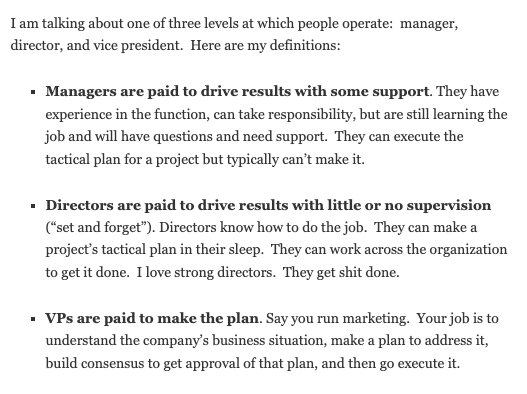


 overheard fragments of people talking about you…even the expressions on your face as they pass you in the hallway. People will extrapolate a lot from a very little, and changing their impression of you later is hard work.
 listening closely to how they talk about their colleagues. Do they complain about being misunderstood or mistreated, do they minimize the difficulty or quality of others’ work, do they humblebrag, or do they take full responsibility for outcomes? And does their empathy fully extend to their peers in other departments, like sales and marketing?

 Instead, ask for specific examples of leadership being forthcoming with bad news to the team, and team members delivering hard feedback or bad news to upper leadership. Transparency shouldn’t be something they’re especially proud of, so much as it is taken for granted. It’s in the air that you breathe.
 relevant to the job in question?
 people they can convince to stay. They aren’t doing you a favor by employing you; you are doing THEM a favor by lending them your creativity, labor, and a third of the hours in your day.
 “engineering-driven” and the asymmetry it implies.
 resonated? What clicked? What worked?


 job is to support those services in production. (There are plenty of software jobs that do not involve building highly available services, for those who are offended by this.) Tossing it off to ops after tests pass is nothing but a thinly veiled form of engineering classism, and you can’t build high-performing systems by breaking up your feedback loops this way.
 This doesn’t have to be cash, it could be a Friday off the week after every on call rotation. The more established and funded a company you are, the more likely you should do this in order to surface the right incentives up the org chart.


 Ditto logs. When I say “logs”, you think “unstructured strings, written out to disk haphazardly during execution, “many” log lines per request, probably contains 1-5 dimensions of useful data per log line, probably has a schema and some defined indexes for searching.” Logs are at their best when you know exactly what to look for, then you can go and find it.
 In order to deliver observability, your tool also needs to support high cardinality and high dimensionality. Briefly, cardinality refers to the number of unique items in a set, and dimensionality means how many adjectives can describe your event. If you want to read more, here is an
 engineering management over to


I received this question in the comments section of my piece on The Twin Anxieties of the Engineer/Manager Pendulum, and figured I might as well answer it. It definitely isn’t a question I’ve spent a lot of time thinking about or anything. 🥰