Every Achievement Has A Denominator

One of the classic failure modes of management is the empire-builder — the managers who measure their own status, rank or value by the number of teams and people “under” them.

Everyone knows you aren’t supposed to do this, but most of us secretly, sheepishly do it anyway to some extent. After all, it’s not untrue — the more teams and people that roll up to you, the wider your influence and the more impact you have on more people, by definition.

The other reason is, well, it’s what we’ve got. How else are we supposed to gauge our influence and impact, or our skill as a leader? We don’t really have any other language, metrics or metaphors readily available to us. 😖

Well… Here’s one:

✨Every achievement has a denominator✨

Organization size can be a liability

Let’s say you have 1,000 people in your org and you collectively achieve something remarkable. Good for you!

What if you achieved the same thing with 10,000 people, instead? What would that say about your leadership?

What if you achieved the same thing with 100 people?

Or even 10 people?

Lots of people take pride in their ability to manage large organizations. And with thousands of people in your org, you kinda better do something fucking great. But what if you instead took pride in your ability to deliver outsize results with a small denominator?

What if comp didn’t automatically bloat with the size of your org, but rather the impact of your work divided by the number of contributors — rewarding leaders for leaner teams, not larger ones?

Bigness itself is costly. There’s the cost of the engineers, managers, product and designers etc, of course. But the bigger it gets, the more coordination costs are incurred, which are the worst costs of all because they do not accrue to any user benefit — and often lead to lack of focus and product surface sprawl.

Constraints fuel creativity. Having “enough” engineers for a project is usually a terrible idea; you want to be constrained, you want to have to make hard decisions about where to spend your time and where to invest development cycles.

More often than not, scope is the enemy

As Ben Darfler wrote earlier this year about our approach to engineering levels at Honeycomb:

There are times when broad scope may be unavoidable, but at Honeycomb, we try to cultivate a healthy skepticism toward scope. More often than not, scope is the enemy. We would rather reward engineers who find clever ways to limit scope by decomposing problems in both time and size. We also want to reward engineers who work on the most important problems for the business, regardless of the size of the project. We don’t want to reward people for gaming out their work based on what will get them promoted.

The same is true for engineering managers, directors and VPs. We would rather reward them for getting things done with small, nimble teams, not for empire building and team sprawl. We want to reward them for working on the most important problems for the business, regardless of what size their teams are.

What was the denominator of the last big project you landed? Could you have done it with fewer people? How will you apply those learnings to the next big initiative?

Can we find more language and ways to talk about, or take pride in how efficiently we do big things? At the very least, perhaps we can start paying attention to the denominator of our achievements, and factor that into how we level and reward our leaders.

charity.

P.S. I did not invent this phrase, but I am unfortunately unable to credit the person I heard it from (a senior Googler). I simply think it’s brilliant, and so helpful.

Every Achievement Has A Denominator

The Hierarchy Is Bullshit (And Bad For Business)

My friend Molly has had an impressive career. She got a job as a software engineer after graduating from college, and after kicking ass for a year or so she was offered a promotion to management, which she accepted with relish. Molly was smart, driven, and fiercely ambitious, so she swiftly clambered up the ranks to hold director, VP, and other shiny leadership roles. It took two decades, an IPO and a vicious case of burnout before she allowed herself to admit how much she hated her work, and how desperately she envied (guess who??) the software engineers she worked alongside. Turns out, all she ever really wanted to do was write code every day. And now, to her dismay, it felt too late.

Why did it take Molly so long to realize what made her happy? I personally blame the fucking hierarchy.

The Hierarchy Lie

The “Big Lie” of hierarchy is that your organizational structure is a vertical tree from the CEO on down, where higher up is always better.

Of course any new grad is going to feel that way, on the heels of 15-20 years spent going through school year by year, grade by grade, measuring success via good grades and teacher approval. The early years of professional life are a similar blend of hard work, leveling up and basic skills acquisition. (They got Molly hopped on the leveling treadmill before she even had a chance to become a real adult, in other words. 😍)

But by the time you are fully baked as a senior contributor, maybe 7-8 years in, your relationship to levels and ladders should undergo a dramatic shift. At some point you have to learn to tune in to your own inner compass. What draws you in to your work? What fuels your growth and success?

Being an adult means not measuring yourself entirely on other people’s definition of success. Personal growth might come in the guise of a big promotion, but it also might look like a new job, a different role, a swing to management or back, becoming well-known as a subject matter expert, mentoring others, running an affinity group, picking up new skill sets, starting a company, trying your hand at consulting, speaking at conferences, taking a sabbatical, having a family, working part time, etc. No one gets to define that but you.

You have a thirty- or forty-year adult life and career in front of you. What the hell are you going to do with all that time and space??

Your career is not one mad sprint to the finish line

Literally nobody’s career looks like a straight line, going up, up up and to the right, from intern to CEO (to a coffin).

One of the most exhausting things about working at Facebook was the way engineering levels feltLiterally no one's career, ever. like a hamster wheel, where every single quarter you were expected to go go go go go, do more do more, scrape up ever more of your mortal soul to pour in more than you could last quarter — and the quarter before that, and before that, in ever-escalating intensity.

It was fucking exhausting, yo. Life does not work that way. Shit gets hilly.

The strategy for a fulfilling, lifelong career in tech is not to up the ante every interval. Nor is it to amass more and more power over others until you explode. Instead:

  1. Train yourself to love the feeling of constantly learning and pushing your boundaries. Feeling comfortable is the system blinking orange, and it should make you uneasy.
  2. Follow your nose into work that lights you up in the morning, work you can’t stop thinking about. If you’re bored, do something else.
  3. Say yes to opportunities!! Intensity is nothing to be afraid of. Instead of trying to cap your speed or your growth, learn to alternate it with recovery periods.
  4. If you aren’t sure what to do, make the choice that preserves or expands future optionality. Remember: Most startups fail. Will you be okay with your choices if (& when) this one does too?

Why do people climb the ladder? “Because it’s there.” And when they don’t have any other animating goals, the ladder fills a vacuum.

But if you never make the leap from externally-motivated to intrinsically-motivated, this will eventually becomes a serious risk factor for your career. Without an inner compass (and a renewable source of joy), you will struggle to locate and connect with the work that gives your life meaning. You will risk burnout, apathy and a serious lack of fucks given..

The times I have come closest to burnout or flaming out have never been when I was working the hardest, but when I cared the least. Or when I felt the least needed.📈📉💔

A disturbing number of companies would rather feel in control than unclench and perform better

But hey! Lack of inner drive isn’t the ONLY thing that drives people to climb the ladder. Plenty of companies fuck this up too, all on their lonesome. Let’s talk about more of the ways that companies mess up the workplace! Like by disempowering the people doing the work and giving all the power to managers, thereby forcing anyone who wants a say in their own job become one.

The way we talk about work is riddled with hierarchical, authoritarian phrases: “She was my superior”, “My boss made me do it”, “I got promoted into management”, and so on.

There are plenty of industries where line workers are still disempowered cogs and power structures are hierarchical and absolute (like flipping burgers at McDonalds, or factory line work). There are even software companies still trying to make it work in command-and-control mode, to whom engineers are interchangeable monkeys that ship story points and close JIRA tasks.

But if there’s one thing we know, it’s that for industries that are fueled by creativity and innovation, command-and-control leadership is poison. It stifles innovation, it saps initiative, it siphons away creativity and motivation and caring.

Studies also show that the more visible someone’s power is, the less likely anyone is to give them honest feedback.[2]

Companies that don’t learn this lesson are unlikely to win over the long run. Engineering is a deeply creative occupation, and authoritarian environments are toxic for creativity and people’s willingness to share information.

Hierarchy is just a data structure

The basic function of a hierarchy is to help us make sense of the world, simplify information, and make decisions. Hierarchy lets us break down enormous projects — like “let’s build a rocket!”, or “let’s invade the moon!” — into millions of bite size decisions and tasks, and this is how progress gets made.

A certain amount of authority is invested into the hierarchy model. If you are responsible for delivering a unit of work, the company needs to make sure you have enough resources and decision-making ability to do so. This is what we think of as the formal power structure [1], and there is nothing wrong with that. It’s what makes the system work.

The problem starts when we stop thinking of hierarchy as a neutral data structure — a utilitarian device for organizing groups and making decisions — and start projecting all kinds of social status and dominance onto it.

A sensitivity to social dominance is wired deep, deep into our little monkey brains. It’s what tells us we deserve more power, leverage, pride, influence, and autonomy — and simply have more value — than those below us. It’s what tells us those above us are better, stronger and more deserving than we are, and that we owe them our respect and deference.

It also tells us “if you lose status, YOU MIGHT DIE” 😱😱😱 which is why we may react to a perceived loss of status with a sting that seems astonishingly extreme and overwrought, even to ourselves, yet somehow impossible to shrug off.

hierarchies tend to get mixed up with social dominance

In general, it is better to pursue roles and growth based on the affirmative (what it is you want to learn, grow or do more of) than the negative (what you want to avoid, evade or stop doing). Your motivation systems don’t kick in to gear when you are feeling “lack of pain” — the system doesn’t work that way. They kick in when you get interested.

And if you are sick of doing something or being treated a certain way, chances are everyone else will hate it, too. Who wants to work at a company where all the shit rolls downhill?

Hierarchies have stuck around for one very good reason: because they work. Hierarchies are simple, intuitive, and allow large numbers to collaborate with low cognitive overhead. Unfortunately, most hierarchies become entwined with status and dominance markers, which can bring enormous downsides. At their worst, they can suck the literal life out of work, reducing us all to glum little cogs obeying orders.

We aren’t getting rid of hierarchy anytime soon. But we can use culture and ritual to gently untangle them from dominance, and we can choose to interpret formal power as a service function instead of a dictatorship. This frees people up to choose their work based on what makes them feel fulfilled, instead of their perceived status. (Also helpful? Flatter pay bands. 😛)

Good managers do not dictate and demand, they nurture, develop, and inspire. The most important roles in the company aren’t held by managers; they are all the little leaf nodes  busily building the product, supporting users, identifying markets, writing copy, etc. The people doing the work are why we exist as a company; all the rest is, with considerable due respect, overhead.

How to drain your hierarchy of social dominance

When it comes to hierarchy and team structure, there are the functional, organizational aspects (mostly good) and the social dominance parts (mostly bad). With that in mind, there are plenty of smaller things we can do as a team to remind people that we are equal colleagues, simply with different roles.

  • Be conscious of the language you use. Does it reinforce dominance and hierarchy? (Step one: stop calling management “a promotion”🥰)
  • De-emphasize trappings of power. The more you refer to someone’s formal power, the less likely anyone is to give them critical feedback or question them.
  • Push back against common but unhelpful practices, like “a manager should always make more money than the people who report to them.” Really? Why??
  • Are there opportunities for career advancement as an IC, or only as a manager? Everyone should have the ability to advance in their career.
  • Do your own dishes, everyone.
  • Practice visualizing the org chart upside down, where managers and execs support their teams from below rather than topping them from above. (I was going to write a whole post about this, then discovered other people have been doing that for the past decade. 🤣)

And then there is the big(ger) thing we can (and must!) do, in order to 1) make people go into management for the right reasons, 2) help senior IC roles remain attractive to highly skilled creative and technical contributors, and 3) encourage everybody to make career decisions based on curiosity, growth, and what’s best for the business, instead of turf and power grabs. Which is:

Practice transparency, from top to bottom

Share authority, decision-making and power

Technical contributors own technical decisions

Most people who go in to management don’t do it out of a burning desire to write performance reviews. They do it because they are fed the fuck up with being out of the loop, or not having a say in decisions over their own work. All they want is to be in the room where it happens, and management tends to be the only way you get an invite.

EVERY company says they believe in transparency, but hardly any of them are, by my count. Transparency doesn’t mean flooding people with every trivial detail, or freaking them out with constant fire drills. It does mean being actively forthcoming about important questions and matters which are happening or on the horizon…often before you are fully comfortable with it. Honestly, if you never feel any discomfort about your level of transparency, you probably aren’t transparent enough.

People do better work with more context! You’re equipping them with information to better understand the business problems and technical objectives, and thereby unleashing them and their creativity to help solve them. You’re also opening yourself up to questioning and sanity checks — which may feel uncomfortable, but 🌞sunlight is sanitizing🌞 — it is worth it.

Some practical tips for transparency

At Honeycomb, we present the full board deck after every board meeting in our all hands, and take questions. When we’re facing financial uncertainty, we say so, along with our working plan for dealing with it. We also do org-level updates in all hands, once per quarter per org. Each org presents a snapshot to the company of how they are doing, but we ask that no more than 2/3 of the presentation be about their successes and triumphs, and 1/3 of their material be about their failures and misses. Normalize talking about failure.

Being transparent isn’t about putting everyone on blast; it’s about cultivating a habit of awareness about what might be relevant to other people. It’s about building systems of feedback, updates and open questioning into your culture. This can be scary, so it’s also about training yourselves as a team to handle hard news without overreacting or shooting the messenger. If you always tell people what they want to hear, they’ll never trust you. You can’t trust someone’s ‘yes’ until you hear their ‘no’.

Transparency is always a balance between information and distraction, but I think these are healthy internal rules of thumb for management:

  1. If anyone has further questions or wants to know more details than what was shared, they are free to ask any manager or exec, who will willingly answer more fully, up to the boundaries of privacy or legal reasons. As employees, they have a right to know about the business they are part of. A right — not a privilege, which can be revoked on a whim.
  2. When making internal decisions about e.g. salary bands, individual exceptions to formal policy, etc, ask each other … if this decision were to leak, could we justify our reasoning with head held high? If you would feel ashamed, or if you really don’t want people to find out about it, it’s probably the wrong decision.

Some practical tips for distributing power

Power flows to managers by default, just like water flows downhill. Managers have to actively push back on this tendency by explicitly allocating powers and responsibilities to tech leads and engineers. Don’t hoard information, share context generously, and make sure you know when they would want to tap in to a discussion. Your job is not to “shield” them from the rest of the org; your job is to help them determine where they can add outsize value, and include them. Only if they trust you to loop them in will they feel free to go heads down and focus.

Wrap your senior ICs into planning and other leadership activities. Decisions about sociotechnical processes (code reviews, escalation points, SLI/SLOs, ownership etc) are usually better owned by staff+ engineers than anyone on the management track. Invite a couple of your seniormost engineers to join calibrations — they bring a valuable perspective to performance discussions that managers lack.

Demystify management. Blur the lines between people managers and engineers; delegate ownership and accountability for some important projects to ICs. Ask every engineer about their career interests, and if management is on the list, find opportunities for them to practice and improve at managerial skills — mentoring, interviewing, onboarding, etc.

Adults don’t like being told what to do

People do phenomenal work when they want to do it, when they are creatively and emotionally engaged at the level of optimum challenge, and when they know their work matters. That’s where you’ll find your state of flow. That is where you’ll do your best work, which is also the best way to get promoted and make durable advances in your career.

Not, ironically, by chasing levels and titles for their own sake. ☺️

People want to be challenged. They want you to ask them to step up and take responsibility for something hard. They want to be needed, and they want to have agency in the doing of it. Just like you do.

Oh yeah, back to Molly …

Molly, who I mentioned at the beginning, joined Honeycomb five years ago as a customer success exec. After realizing she wanted to go back to engineering, she switched to working our support desk to build up her technical chops while she practiced writing code on the side. She has now been working as a software engineer on the product team for over two years, and she is ✨rocking it.✨ It is NEVER too late. 🙌

<3 charity

p.s. Molly also says, “don’t waste time at bad companies, whether you’re climbing the ladder or not!” 🥂


[1] Formal power is only one kind of power, and in some ways it is the weakest, because it doesn’t belong to you. It belongs to the company and is only loaned out for you to wield on its behalf. (You don’t carry the innate ability to fire people along with you after you stop being an engineering manager, for example.) Formal powers are limited, enumerated, and functional. You don’t get to use them for any reason other than furthering the goals of the org, or else it is literally an abuse of power.

Formal power is fascinating in another way, too: which is that your formal power is seen as legitimate only if you ~basically always wield it in the ways everyone already expects you to. You can make a surprising call only so often; you can straight up overrule the wishes of your constituents extremely rarely. If you use your formal power to do things that people disagree with or don’t support, without taking the time to persuade them or create real consensus, you will squander your credibility and good faith unbelievably fast.

[2] I am not going to bother rustling up lots of links and citations, because I expect most of this falls into the voluminous category of “shit you already knew”. But if any of it sounds surprising to you, here are some classic reference works:

Flow, by Mihaly Csikszentmihalyi
Drive, by Dan Pink
The Culture Code: Secrets of Successful Groups, by Daniel Coyle
A Lapsed Anarchist’s Guide to Being a Better Leader, by Ari Weinzweig

[3] The scientific literature suggests that dominating instincts tend to emerge in more overtly hostile environments. Make of that what you will, I guess.


Some other writing I have done on this topic, or topics adjacent …

The Engineer/Manager Pendulum
The Pendulum or the Ladder
If Management Isn’t a Promotion, then Engineering isn’t a Demotion
Twin Anxieties of the Engineer Manager Pendulum
Things to Know About Engineering Levels
Advice for Engineering Managers who want to Climb the Ladder
On Engineers and Influence
Is There a Path Back from CTO to Engineer?

The Hierarchy Is Bullshit (And Bad For Business)

Rituals for Engineering Teams

Last weekend I happened to pick up a book called “Rituals For Work: 50 Ways To Create Engagement, Shared Purpose, And A Culture That Can Adapt To Change.” It’s a super quick read, more comic book than textbook, but I liked it.

It got me thinking about the many rituals I have initiated and/or participated in over the course of my career. Of course, I never thought of them as such — I thought of them as “having fun at work” 🙃 — but now I realize these rituals disproportionately contribute to my favorite moments and the most precious memories of my career.

Rituals (a definition): Actions that a person or group does repeatedly, following a similar pattern or script, in which they’ve imbued symbolism and meaning.

I think it is extremely worth reading the first 27 pages of the book — the Introduction and Part One. To briefly sum up the first couple chapters: the power of creative rituals comes from their ability to link the physical with the psychological and emotional, all with the benefit of “regulation” and intentionality. Physically going through the process of a ritual helps people feel satisfied and in control, with better emotional regulation and the ability to act in a steadier and more focused way. Rituals also powerfully increase people’s sense of belonging, giving them a stable feeling of social connection. (p. 5-6)

The thing that grabbed me here is that rituals create a sense of belonging. You show that you belong to the group by participating in the ritual. You feel like you belong to the group by participating in the ritual. This is powerful shit!

It seems especially relevant these days when so many of us are atomized and physically separated from our teammates. That ineffable sense of belonging can make all the difference between a job that you do and a role that feeds your soul. Rituals are a way to create that sense of belonging. Hot damn.

So I thought I’d write up some of the rituals for engineering teams I remember from jobs past. I would love to hear about your favorite rituals, or your experience with them (good or bad). Tell me your stories at @mipsytipsy. 🙃

Rituals at Linden Lab

Feature Fish Freeze

At Linden Lab, in the ancient era of SVN, we had something called the “Feature Fish”. It was a rubber fish that we kept in the freezer, frozen in a block of ice. We would periodically cut a branch for testing and deployment and call a feature freeze. Merging code into the branch was painful and time consuming, so If you wanted to get a feature in after the code freeze, you had to first take the fish out of the freezer and unfreeze it.

This took a while, so you would have to sit there and consider your sins as it slowly thawed. Subtext: Do you really need to break code freeze?

Stuffy the Code Reviewer

You were supposed to pair with another engineer for code review. In your commit message, you had to include the name of your reviewer or your merge would be rejected. But the template would also accept the name “Stuffy”, to confess that your only reviewer had been…Stuffy, the stuffed animal.

However if your review partner was Stuffy, you would have to narrate the full explanation of Stuffy’s code review (i.e., what questions Stuffy asked, what changes he suggested and what he thought of your code) at the next engineering meeting. Out loud.

Shrek Ears

We had a matted green felt headband with ogre ears on it, called the Shrek Ears. The first time an engineer broke production, they would put on the Ears for a day. This might sound unpleasant, like a dunce cap, but no — it was a rite of passage. It was a badge of honor! Everyone breaks production eventually, if they’re working on something meaningful.

If you were wearing the Shrek Ears, people would stop you throughout the day and excitedly ask what happened, and reminisce about the first time they broke production. It became a way for 1) new engineers to meet lots of their teammates, 2) to socialize lots of production wisdom and risk factors, and 3) to normalize the fact that yes, things break sometimes, and it’s okay — nobody is going to yell at you. ☺️

This is probably the number one ritual that everybody remembers about Linden Lab. “Congratulations on breaking production — you’re really one of us now!”

Vorpal Bunny

vorpal bunny

We had a stuffed Vorpal Bunny, duct taped to a 3″ high speaker stand, and the operations engineer on call would put the bunny on their desk so people knew who it was safe to interrupt with questions or problems.

At some point we lost the bunny (and added more offices), but it lingered on in company lore since the engineers kept on changing their IRC nick to “$name-bunny” when they went on call.

There was also a monstrous, 4-foot-long stuffed rainbow trout that was the source of endless IRC bot humor… I am just now noticing what a large number of Linden memories involve stuffed animals. Perhaps not surprising, given how many furries were on our platform ☺️

Rituals at Parse

The Tiara of Technical Debt

Whenever an engineer really took one for the team and dove headfirst into a spaghetti mess of tech debt, we would award them the “Tiara of Technical Debt” at the weekly all hands. (It was a very sparkly rhinestone wedding tiara, and every engineer looked simply gorgeous in it.)

Examples included refactoring our golang rewrite code to support injection, converting our entire jenkins fleet from AWS instances to containers, and writing a new log parser for the gnarliest logs anyone had ever seen (for the MongoDB pluggable storage engine update).

Bonfire of the Unicorns

We spent nearly 2.5 years rewriting our entire ruby/rails API codebase to golang. Then there was an extremely long tail of getting rid of everything that used the ruby unicorn HTTP server, endpoint by endpoint, site by site, service by service.

When we finally spun down the last unicorn workers, I brought in a bunch of rainbow unicorn paper sculptures and a jug of lighter fluid, and we ceremonially set fire to them in the Facebook courtyard, while many of the engineers in attendance gave their own (short but profane) eulogies.

Mission Accomplished

This one requires a bit of backstory.

For two solid years after the acquisiton, Facebook leadership kept pressuring us to move off of AWS and on to FB infra. We kept saying “no, this is a bad idea; you have a flat network, and we allow developers all over the world to upload and execute random snippets of javascript,” and “no, this isn’t cost effective, because we run large multi-terabyte MongoDB replica sets by RAIDing together multiple EBS volumes, and you only have 2.5TB FusionIO (for extremely high-perf mysql/RocksDB) and 40 TB spinning rust volumes (for Hadoop), and also it’s impossible to shrink or slice up replsets”, and so forth. But they were adamant. “You don’t understand. We’re Facebook. We can do anything.” (Literal quote)

Finally we caved and got on board. We were excited! I announced the migration and started providing biweekly updates to the infra leadership groups. Four months later, when the  migration was half done, I get a ping from the same exact members of Facebook leadership:

“What are you doing?!?”
“Migrating!”
“You can’t do that, there are security issues!”
“No it’s fine, we have a fix for it.”
“There are hardware issues!”
“No it’s cool, we got it.”
You can’t do this!!!”

ANYWAY. To make an EXTREMELY long and infuriating story short, they pulled the plug and canned the whole project. So I printed up a ten foot long “Mission Accomplished” banner (courtesy of George W Bush on the aircraft carrier), used Zuck’s credit card to buy $800 of top-shelf whiskey delivered straight to my desk (and cupcakes), and we threw an angry, ranty party until we all got it out of our systems.

Blue Hair

I honestly don’t remember what this one was about, but I have extensive photographic evidence to prove that I shaved the heads of and/or dyed the hair blue of at least seven members of engineering. I wish I could remember why! but all I remember is that it was fucking hilarious.

In Conclusion

Coincidentally (or not), I have no memories of participating in any rituals at the jobs I didn’t like, only the jobs I loved. Huh.

One thing that stands out in my mind is that all the fun rituals tend to come bottoms-up. A ritual that comes from your VP can run the risk of feeling like forced fun, in a way it doesn’t if it’s coming from your peer or even your manager. I actually had the MOST fun with this shit as a line manager, because 1) I had budget and 2) it was my job to care about teaminess.

There are other rituals that it does make sense for executives to create, but they are less about hilarious fun and more about reinforcing values. Like Amazon’s infamous door desks are basically just a ritual to remind people to be frugal.

Rituals tend to accrue mutations and layers of meaning as time goes on. Great rituals often make no sense to anybody who isn’t in the know — that’s part of the magic of belonging. 🥰

Now, go tell me about yours!

charity

Rituals for Engineering Teams

Giving Good Feedback: Consider the Ratio

Consider the ratio.

You work with someone great. If someone asked, you’d say they are brilliant, inspired and dedicated. They care deeply about their work, they are timely and reliable (for the most part), and their emojis and dry sense of humor brighten your day. Your work depends on theirs, and you are working together on a neat project which is generating lots of excitement at demo days. You would miss them terribly if they left.

But today you are annoyed. They either didn’t hear or forgot your feedback from the last design review, which means you have to redo some components you thought were finished. It’s a considerable amount of work, and this isn’t the first (or second) time, either. You want to tell them so and try to debug this so it doesn’t keep happening.

So far, so good. Giving feedback like this can be hard, especially if they are senior to you. But do they understand the totality of how you see them? Or was the last time they heard from you the last time they fucked up? Out of the last ten times you gave them feedback, how many were complaining or asking for changes? Does that feedback ratio accurately represent your perception of their value?

This doesn’t mean you have to run around saying “you’re amazing!” all the time, but do be mindful of how other people think you perceive them. I can pretty much guarantee that none of the people you love working with realize just how much you value them, but they are acutely aware of all the ways they fall short or fail you. Here are some ways to correct that imbalance a bit

  • Don’t be vague. Do be specific. If you just run around saying “You’re awesome!” to people, they will tune you out. Do try to notice and reflect some of the things that making working with them a joy. Like, “I learned so much about mysql indexes pairing with you today, thank you”, or “Last week in our practice session you suggested approaching it this way, and it was so helpful in my situation”, or “I really admire the way you can talk extemporaneously about $topic, and I LOVE knowing I can rely on you with zero prep”. This is harder, and it absolutely takes more work on your part, but it lands. And sticks.
  • Use the Situation, Behavior, Impact framework…but for praise. The SBI framework is designed for delivering hard feedback, but it works just as well for delivering kudos. Use it to give great praise that isn’t generic and does let people know what they’re doing right/what they mean to you. “In the last team meeting, your overview of the messaging framework was super eye-opening for me. I learned more than ever before about not just our pyramid, but how messaging frameworks in general are used. I understand its impact on my role better now than I have in seven years of product marketing!”
  • Ground critique in your overall reaction. Let’s say someone just presented an idea that you think is super interesting and potentially very high value, but you have questions about its impact on marginalized groups. Do they know you think it is interesting and high value, when you launch into your critique? No they do not. If all they hear is several rounds of criticism, they may very well give up and cancel altogether, thinking everyone hated it. Something as simple as starting with “I LOVE this idea. Have you thought about —”, or “This is really interesting, but I’m curious…” can be enough to convey a less discouraging, more accurate sense of your perspective.
  • Don’t hold out for the “wow” moments. Sometimes even sharing what you see as a neutral description of someone’s work can be mind-blowing and affirming. Most people don’t realize how much they are just noticed, full stop. It is flattering to be noticed or have the things you said remembered. Being seen can be enough. (h/t @eanakashima)
  • Don’t contribute to a pile-on. Feedback is asymmetric — you can only give feedback as one person at a time (you!), but the recipient might be grappling with negative feedback from many, many people. In that context, anything critical you say is likely to feel like one more rock in a public stoning. Or (somewhat less dramatically), if someone asks for feedback and receives a wave of criticism, they may feel deflated and defeated and drop the entire idea. If that isn’t the outcome you want, try to bring some positive balance to the discussion instead of piling on.
  • Give feedback to grow on. Pure positivity can sound cloying and be easy to discount. If you’re just praising me, I’m learning nothing from it. We’re not talking about a shit sandwich here, but the best compliments are the ones you learn something from. “That was GREAT. It might be even better if…” Relatedly, some people find it hard to believe purely positive feedback, but if you give feedback that shows you understand their work and what they did less well, you gain credibility and they will believe the praise. (h/t @inert_wall).

Hard conversations and corrective feedback are absolutely necessary at times. But even poorly-delivered critiques can be dealt with in the context of a good relationship, when the person knows how much you value them, and even the most delicately delivered criticism can be hard to hear from someone when all you ever seem to hear from them is how much you suck.

Engineers can be the worst at this, because we tend to show our interest by eagerly engaging with an idea or piece of work … by picking it apart, and chattering about all the ways it could be better. 🙃 I generally think this is an awesome way to show love, but we could stand to be clearer about the affection part, and not let the perfect be the enemy of the good. So please consider the ratio of critique vs affirmation when giving feedback.

And there’s no reason to save all the nice words and praise and gratitude for someone’s funeral (or when they leave the company ☺️).

Giving Good Feedback: Consider the Ratio

Advice for Engineering Managers Who Want to Climb the Ladder

We have been interviewing and hiring a pile of engineering directors at Honeycomb lately. In so doing, I’ve had some fascinating conversations with engineering managers who have been trying unsuccessfully to make the leap to director.

Here is a roundup of some of the ideas and advice I shared with them, and the original twitter thread that spawned this post.

What is an engineering director?

Given all the title inflation and general inconsistency out there, it seems worth describing what I have in mind when I say or hear “Engineering Director.”

In a traditional org chart, an engineering manager usually manages about 5-8 engineers, an engineering director manages 2-5 engineering managers, and a VP of engineering manages the directors. (At big companies, you may see managers and directors reporting to other managers and directors, and/or you may find a bunch of ‘title padding’ roles like Senior Manager, Senior Director etc.)

In smaller companies, it’s common to have a “Head of Engineering” (this is an appropriately weaselly title that commands just the right amount of respect while leaving plenty of space to hire additional people below or above them). Or all of engineering might roll up to a director or VP or CTO. It varies a lot.

When it comes to the work a director is expected to do, though, there’s a fair bit of consistency: we expect managers to manage ICs, and directors to manage managers.  Directors sit between the line managers and the strategic leadership roles. (More on this later.)

So if you’re an engineering manager, and you want to try being a director, the first thing you’ll want to understand is this: it is generally better to get there by being promoted than by getting offered a director title at a different company.

How to level up

Lots of engineers get tapped by their management to become managers, but not many become directors without a conversation and some intentional growth first. This means that for many of you, trying to become a director may be the first time you have ever consciously solicited a role outside the interview process. This can bring up feelings of awkwardness, even shamefulness or inappropriateness. You’ll just have to push through those.

If you ever want a job in upper leadership, you are going to have to learn how to shamelessly state your career goals. We want people in senior leadership who want to be there and are honing their skills in anticipation of an opportunity. Not “oops, I accidentally a VP.”

It is better to get promoted than hired up a level

There are a few reasons for this. It’s usually easier to get promoted than to get hired straight into a job you’ve never held before (at a org with high standards), and it also tends to be more sustainable/more likely to succeed if you get promoted in as well. Being a director is NOT just being a super-duper manager, it’s a different role and function entirely.

A lot of your ability to be successful as a director (or any kind of manager) comes from knowing the landscape, the product and the people, and having good relationships internally. When you are internally promoted, you already know the company and the people, so you get a leg up towards being successful. Whereas if you’ve just joined the company and are trying to learn the tech, the people, the relationships, and how the company works all at once, on top of trying to perform a new role for the first time.. well, that is a lot to take on at once.

There are exceptions, sure! Oodles of them[1]. But I would frankly look sideways at a place that wanted to hire me as a director if I haven’t been one, or hadn’t at least managed managers before. It’s at least a yellow flag. It tells me they are probably either a) very desperate or b) very sloppy with handing out titles.

If you want a promotion…

The obvious first step involves asking your manager, “what is the skill gap for me between the job I am doing right now and a director role?” Unlike in the movies, promotions don’t usually get surprise-dropped on people’s heads; people are usually cultivated for them. Registering your interest makes it more likely they will consider you, or help you develop skills in that direction as time moves on.

If you have a good manager who believes in you, and the opportunities exist at your company, that might even be all you have to do.(!)

And if so, lucky you. But as for the remaining ~80-90% of us (ha!) … well, we’ll need a bit more hustle.

Take inventory of your opportunities

Lots of companies aren’t large enough to need directors, or growing fast enough to create new opportunities. This can actually be the most challenging part of the equation, because there are generally a lot more managers who want to be directors than there are available openings.

If you do need to find a new job to reach your career goals, I would target fast-growing companies with at least 100 engineers. If you’re evaluating prospective employers based on your chance of advancement, consider the following::

  • Ask about their policies on internal vs external hires. Do they give preference to existing employees? How do they decide when to recruit vs grow from within?
  • Ask about the last time that someone was promoted into a similar role.
  • Tell the recruiter and hiring manager about your career goals. Don’t be shy. “My next career goal is to gain some experience managing managers” is fine. (That shouldn’t be the only reason you’re interested, of course.)
  • Size up the playing field. Is there oxygen at that level? Or are there a dozen other managers senior to you lined up for the same shot?

There are no sure bets. But you can do a lot to put yourself in the right place at the right time, signal your interest, and be prepared for the opportunity when it strikes.

a director is not a ‘super-senior manager’

A director is not just a manager on steroids: it is an entirely different job. It helps to have been a good manager before becoming a director, because many management skills will translate, but others will be entirely new to you. Expect this.

How being a good director is different from being a good manager

Let’s look at some of the ways that being a good engineering manager is different than being a good director.

  1. You can be a great EM, beloved by your team, without giving much thought to managing out or up. Directors cannot. If anything, it’s the opposite. You may get away with not coddling your EMs, but you must pull your weight for your peers and upper management.
  2. You can have a bit of a reputation for being stubborn or difficult as an EM, and that can be just fine. But having such a rep will probably sabotage your attempt at being promoted to director.
  3. You can be a powerful technical EM who sometimes jumps in to train engineers, be on call, or course correct technical and architectural decisions. This can even burnish your value and reputation as an EM. But this would all be a solid knock against you as a director.

Managers can get away with being opinionated and attached to technology, to some extent, while directors absolutely must balance lots of different stakeholders to achieve healthy business outcomes.
This difference of perspective is why managers will sometimes sniff about directors having sold out, or being “all about politics.”

(Blaming something on “politics” is usually a way of accidentally confessing that you don’t actually understand the constraints someone is operating under, IMO.)

A director’s job is running the business

Here’s the key fact: ✨directors run the business✨.

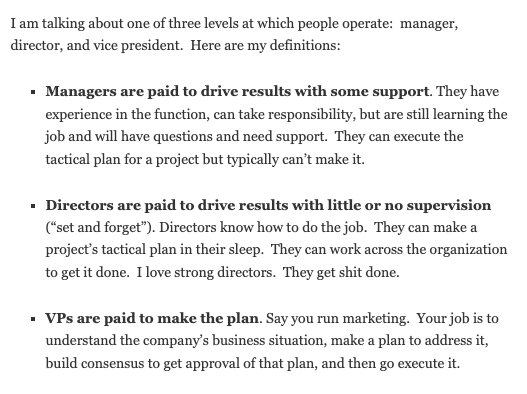
Managers should be focused on high-performing engineering teams. VPs should be focused on strategy and the longer term. Directors are the execution machines that knit technology with business objectives. (I like this piece, although the lede is a little buried. Key graf:)

managers, directors, VPs

Directors run the business. They are accountable for results. You can’t be bopping in and writing or reviewing code, or tossing off technical opinions. That’s not your job anymore.

Managing managers is a whole new skill set

The distance between managing engineers and managing managers is nearly as vast as the gulf between being an engineer and being a manager.

But it’s sneakier, because you don’t feel out of your depth as much as you did when you became a manager. 😁

As a manager, each of us instinctively draws on our own unique blend of strength and charisma — whatever it is that makes people look up to you and willing to accept your influence. Most of us can’t explain how we do it, because we run on instinct.

But as a director, you have to figure it out. Because you need to be able to debug it when the magic breaks down. You need to help your managers influence and lead using *their* unique strengths. What works for you won’t work for them. You have to learn how to unpack different leadership styles and support them in the way they need.

If you’re working towards a director role:

There are lots of areas where you can improve your director skills and increase your chances of being viewed as director material without any help whatsoever from your manager.

You ✨can not✨ be a blocker

Directors run the business … so you CANNOT be seen as a blocker. People must come to you of their own accord to get shit done and break through the blockers.

If they are going to other people for advice on how to break through YOU, you are not a good candidate for director. Figure out how to fix this before you do anything else.

Demonstrate impact beyond your team(s)

Another way to make yourself an attractive prospect for director is to work on systemic problems, driving impact at the org or company level. You could:

  • work to substantially increase the diversity of your teams or your candidate pipeline, and offer to work with recruiting and other managers to help them do the same (becoming BFFs with recruiting is often a canny move)
  • drive some cross-platform initiative to consolidate dozens of snowflake deploy processes and significantly reduce CI/CD build/deploy times, set an internal SLO for artifact build times, or successfully champion auto-deployment
  • champion an internal tools team with a mandate to increase developer productivity, and quantify the hell out of it
  • lead a revamp of the new hire onboarding process. Or add training and structure to the interview process and set an SLO of responding to every candidate within one week

I dunno — it all depends on what’s broken at your company. 🙃 Identify something causing widespread pain and frustration at the organizational level and fix it. 

Managing ‘up’ is not a ‘nice-to-have’…

If there’s a problem, make sure you are the one to bring it to your manager (and swiftly), along with “Here is the context, here’s where I went wrong, and this is what I’m planning to do about it.” No surprises.

At this point in your career, you should have mastered the art of not being a giant pain in the ass to your manager. Nobody wants a high-maintenance director. Do you reliably make problems go away, or do they boomerang back five times worse after you “fix” them?

…Neither is managing ‘out’

Managing “out” is important too. (Not “managing out”, which means terminating people from the company, but managing “out” as in horizontally, meaning your relationship with your peers.)

What do your peers think of you? Do you invest in those relationships? Do they see you as an ally and a source of wise counsel, or a source of chaos, gossip and instability, or a competitor with turf to protect? If you’re the manager that other managers seek out for a peer check, you might be a good candidate for director.

psst.. People are watching you

One of the most uncomfortable things to internalize if you climb the ladder is how much people will make snap judgments about you based on the tiniest fragments of information about you, and how those judgments may forever color the way they think of you or interact with you.

First impressions might be made by ten minutes together on the same zoom call…a few overheard fragments of people talking about you…even the expressions on your face as they pass you in the hallway. People will extrapolate a lot from a very little, and changing their impression of you later is hard work.

(Yes it’s frustrating, but you can’t really get upset about it, because you and I do it too. It’s part of being human. )

Because of that, you really do have to guard against being too cranky, too tired, or out of spoons. People WILL take it personally. It WILL come back to hurt you.

Remember, you don’t hear most feedback. If you visibly disagree with someone, assume 10x as many silently agree with them. If one person gives you a piece of hard feedback, assume 10x as many will never tell you. Be grateful. The more power you are perceived to have, the less feedback you will ever hear.

Pro tip

You can infer a surprising amount about how good a director candidate may be at their job, simply by listening closely to how they talk about their colleagues. Do they complain about being misunderstood or mistreated, do they minimize the difficulty or quality of others’ work, do they humblebrag, or do they take full responsibility for outcomes? And does their empathy fully extend to their peers in other departments, like sales and marketing?

Does it sound like they enjoy their work, and look forward to beginning it every day? Does it sound like they are all in the same little tugboat, all pulling in the same direction, or is there a baseline disconnect and lack of trust?

In conclusion…

Be approachable, be a drama dampener, project warmth. Control your calendar and carve out regular focus time. Guard your energy — never run your engine under 30%, and always leave something in the tank.

There are a lot more great responses and advice in the replies to my thread, btw. Go check them out if you’re interested.. and if you have something to say, contribute!.☺️

charity

Footnotes:

[1] Occasionally, it may work out to your benefit to jump into a new, higher title at a new company. This can happen when someone is already well qualified for the higher role, but is finding it difficult to get promoted (possibly due to insufficient opportunity or systemic biases). Just be aware that the job you were hired into is likely to be one where the titles are meaningless and/or the roles are chaotic. You may want to stay just long enough to get the title, then bounce to a healthier org.

Advice for Engineering Managers Who Want to Climb the Ladder

Twin Anxieties of the Engineer/Manager Pendulum

I have written a lot about the pendulum swing between engineering and management, so I often hear from people who are angsting about the transition.

A quick recap of the relevant posts:

There are two anxieties I hear people express above all the rest.

The first one is something I hear over and over again, particularly from first-time managers as they contemplate the possibility of leaving management and returning to IC (individual contributor) work as an engineer:

“What if I never get another shot at people management?”
“Maybe this is the only chance I’ll ever get … and I’m about to give it up??”
“Am I going to regret this?”

“Will I ever get another shot at management?”

People decide to go back to engineering for lots of reasons. Maybe they’re burned out, or they work someplace with a poisonous management culture, or they’re having a kid and want to return to a role that feels more comfortable for a while. Or maybe they’ve been managing teams for a few years now, and have decided it’s time to go back to the well and refresh their technical skills in the interest of their long-term employability.

Regardless, these are not typically people who disliked being a manager. Rather they tend to be engineers who really enjoyed people management, and find it bittersweet to give up. Maybe they will miss the strategic elements and roadmap work, but they’re excited to clear their calendar and spend time in flow again, or they will miss having 1x1s but can’t wait to have time to mentor people. Whatever. They want to manage teams again someday, and worry they won’t get another chance.

Their anxiety is understandable! Lots of people feel like they waited a long time to be tapped for management, or like they were passed over again and again. Our cultural scripts about management definitely contribute to this sense of scarcity and diminution of agency (i.e. that management is a promotion, it is bestowed on you by your “superiors” as a reward for your performance, and it is pushy or improper to openly seek the role for yourself).

This anxiety is also, in my experience, ridiculously misplaced. ☺️

Once a manager, marked for life as a manager

You may have struggled to get your first opportunity to manage a team. But it’s a whole different story once you’ve done the job. Now you have the skills and the experience, and people can smell it on you.

I’m not joking. If you’re a good manager it’s actually nearly impossible to hide that you have the skills, because of the way it infuses your work and everything that you do as an IC. You get better at prioritization, more attuned to the needs of the business, and restless about work that doesn’t materially move the business forward. You get better at asking questions about why things need to be done and at communicating with stakeholders. You get better at motivating the people you work with, understanding their motivations and your own, and mediating conflicts or putting a damper on drama between peers. People come to you for advice and may seem to just do what you say, or go where you point.

Senior engineers with management experience are worth their weight in gold. They are valuable contributors and influential teammates. It’s a palpable shift! And every experienced manager in their vicinity will sense it.

So yes, you will be tapped for management again. And again and again and again. You are more likely to spend the rest of your career fending off management “opportunities” with a baseball bat than you are to wither away, pining for another shot.

There is a chronic shortage of good engineering managers, just like there is a chronic shortage of good, empathetic managers in every line of work. The challenge you will face from now on will not be about getting the chance to manage a team, but about being intentional and firm in carving out the time you need to recover and recharge your skills as an engineer.

“Am I too rusty to go back to engineering?”

The second anxiety is in some ways a mirror of the first:

“Can I still perform as an engineer?”
“Will anyone hire me for an engineering role?”
“Has it been too long, am I too rusty, will I be able to pull my weight?”

This is a more materially valid concern than the first one, in my opinion. Your engineering skills do wither and erode as time goes on. It will take longer and longer to refresh your skills the longer you go without using them. Management skills don’t decay in the same way that technical ones do, nor do they go out of date every few years as languages, frameworks and technologies tend to do.

If you aren’t interested in climbing the ladder and becoming a director or VP — or rather, if you aren’t actively, successfully climbing the ladder — you should have a strategy for keeping your hands-on skills sharp, because your ability to be a strong line manager is grounded in your own engineering skills.

Never, ever accept a managerial role until you are already solidly senior as an engineer. To me this means at least seven years or more writing and shipping code; definitely, absolutely no less than five. It may feel like a compliment when someone offers you the job of manager — hell, take the compliment 🙃 — but they are not doing you any favors when it comes to your career or your ability to be effective.

When you accept your first manager job, I think you should make a commitment to yourself to stick it out for two years. That’s how long it takes to rewire your instincts and synapses, to learn enough that you can tell whether you’re doing a good job or not.

After two or three years of management, it’s still pretty easy to go back to engineering. After five years, it gets progressively harder. But it can be done. And it should be worth it to your employer to invest in keeping you while you refresh your skills over the six months or whatever it may take. Insist on it, if you must. It’s better to refresh your skills while employed, on a system and codebase you’re familiar with, than to find yourself struggling to brush up enough to pass a coding interview.

Engineering fluency == job security

There is one more reason to refresh your engineering skills from time to time, one I don’t often see mentioned, and that is job security and optionality.

The higher you go up the ladder, the more money you will get paid…but the fewer jobs there be, and the fewer still that match your profile.

As a senior software engineer, there are fifteen bajillion job openings for you. Everyone wants to hire you. You can get a new job in a matter of days, no matter how picky you want to be about location, flexibility, technologies, product types, whatever. You’ve reached Peak Hire.

If you are looking for management roles, there will be an order of magnitude fewer opportunities (and more idiosyncratic hiring criteria), but still plenty for the most part. But for every step up the ladder you go, the opportunities drop by another order of magnitude, and the scrutiny becomes much more intense and particular. If you’re looking for VP roles, it may take months to find a place you want to work at, and then they might not choose you. ¯\_(ツ)_/¯

Maintaining your technical chops is a stellar way to hedge against uncertainties and maintain your optionality.


Twin Anxieties of the Engineer/Manager Pendulum

How can you tell if the company you’re interviewing with is rotten on the inside?

How can you tell the companies who are earnestly trying to improve apart from the ones who sound all polished and healthy from the outside, whilst rotting on the inside?

This seems to be on a lot of minds right now, what with the Great Resignation and all. There are no perfect companies, just like there are no perfect relationships; but there are many questions and techniques you can use to increase your confidence that a particular company is decent and self-aware, one whose quirks and foibles you are compatible with.

https://twitter.com/jetpack/status/1486212123525287938

Interviews are designed to make you feel like you are under inspection, like the interviewer holds all the power. This is an illusion. Your labor is valuable — it is vital — and you should be scrutinizing them every bit as closely as they you. In fact, here is Tip #1:

  • If they allow you plenty of time to converse with your interviewers throughout the process, great. If they tack on a cursory “any questions for us?” while wrapping up, they don’t think it matters what you think of them. Pull the ripcord.

Collect and practice good interview questions for you to ask potential employers. Write them down — your mind is likely to go blank under stress, and you don’t want to let them off the hook. There is a LOT of signal to be gained by probing down below the surface answers.

Backchanneling

  1. Whisper networks and backchannels are incredibly important. It can be especially valuable to talk to someone who has recently left the company: why did they leave? Would they go there again?
  2. Alternately, do you know anyone who has worked for or with their leadership, even if not at that company?
  3. If you know any women or under-represented minorities (URM) who work there, buy them lunch and ask for the unvarnished truth. That’s where you usually turn up the real dirt. 🥂

Diversity, equity and inclusion

Just because a company has a diverse workforce doesn’t necessarily mean it is a healthy place to work. (But it’s fair to give some points up front, because that doesn’t usually happen by accident.)

  1. Do they have a diverse leadership team? A diverse board?
  2. Is their company diverse overall, or are minorities concentrated in a few (lower-paying, high-turnover) departments?
  3. You might not want to write off all the companies that don’t meet points one and two, if for no other reason than it dramatically shrinks your available option pool. If they don’t have a particularly diverse team, and this is something that matters to you, that’s your cue to dig deeper:
    • Are they bothered by their lack of diversity? What’s the plan? Do they just feel generically sad about it, or have they set specific goals to improve by specific dates? What investments are they making?
    • Who works on DEI stuff currently? (Answers like “HR and recruiting”, or “we have a woman who’s really good at it” are bad answers.)
    • Who is accountable for making sure those goals are hit? (The only right answer is “our execs”. Having a “chief diversity officer” is an anti-pattern in my book.)
    • If the team is all guys, for example, ask if they’ve ever had any women on the team in the past. Did she/they leave? Do they know why?
  4. This is a GREAT one: “As a white man, I’d ask what they’ve done to find qualified women and minorities for the role I’m interviewing for.” (via David Daly) 🔥🔥

Company stuff

  1. What are their values? Do they feel bloodless and ripped from the pages of HBR, or are they unique, lived-in, and give you a glimpse of what the people there care about? Are they mentioned over the course of your interview?
  2. Ask tough questions about the business and try to ascertain whether they are hitting their quarterly goals, how much funding they have in the bank, what the growth curve looks like, what users really think about their product, and what the biggest obstacles to success are.
    • Companies that are floundering are going to be really stressful places to work, and even if the leadership is decent, they may find themselves backed into making some really tough decisions.
    • You want to work at a company on a strong growth trajectory for lots of reasons, but a big one is your own growth potential. You will learn the most the fastest at places that are growing fast, and have way more openings for promotions and leadership roles than a slower-growing company.
  3. Are people willing to speak freely about things they’ve tried that have failed, and things that don’t work well currently? Being self-aware and comfortable with visible failure are two of the most important self-correcting mechanisms a company can cultivate.
  4. EVERYBODY thinks they value transparency, so I wouldn’t even bother asking. Instead, ask for specific examples of leadership being forthcoming with bad news to the team, and team members delivering hard feedback or bad news to upper leadership. Transparency shouldn’t be something they’re especially proud of, so much as it is taken for granted. It’s in the air that you breathe.

Planning and the unplanned

  1. Ask about how decisions get made. A chestnut is, “how does work end up on my plate?” — meaning is there a business strategy (owned by whom?), a technical strategy, a product strategy, quarterly KPIs, customer requests, manager delegation, JIRA tickets…? (The most important part may be how similar the answers you get are. 🙃)
  2. How often does work get pre-empted and why? It’s a good thing if product development has to get put on ice once in a while so the team can focus on reliability and maintenance work. It’s a bad thing if they’re expected to stuff reliability work in the cracks around their product development, or if they’re incapable of sticking to a plan.
  3. What does “crunch time” look like? Nearly every company has one from time to time (it might even be a bad sign if it never happens), but this is when you find out your leadership’s true colors.
    • Do they praise people or call them out to thank them for pulling all nighters and other extremist behaviors? 🚨BZZT🚨
    • Is it voluntary? Are you trusted to set your own pace, your own limits, or are you pressured to do more? Are people expected to participate to the extent that they are able, and not expected to justify how hard or how much (so long as they communicate their capacity, of course)?
    • How long did it last, and how often does it happen, and why? It should be rare (1-2x/year at most), involve the whole company, and move the business forward meaningfully
    • Did they follow through by making sure people took time off afterwards to recover? Not just give permission, but actually make sure the human beings had a chance to refresh themselves? Did leaders set a good example by taking a breather themselves?

Believe it or not, crunch time done correctly can be an enormously exciting, intense, bonding time for a group of people who love what they do, culminating in a surge of collective triumph and celebration, followed by recovery time. If it was done correctly, and you ask about it afterwards, people will 💡light up💡.

Team stuff

  1. Unfortunately, culture can vary widely from function to function, even from manager to manager. Make sure you get a real interview slot with your actual manager — not just a screener or wrap-up call — and as much of the team as possible, too.
  2. Ask your potential manager about the last person they had to let go. Why? What was the process? What was the impact on the team? How did the person feel afterwards?
  3. Who is on call? How often do people get paged outside of hours, and how frequently do they work an incident? (Do managers track this?) Are you expected to keep shipping product during on call weeks, or devote your time to making the system better?
  4. If you had to ship a single line of code to production using the deploy pipeline, how long would that take? Remember, the lower the deploy interval, the happier and more productive you are likely to be as an engineer there. Under 15 minutes is great. Under an hour is tolerable. More than that, proceed with great caution.

The interview itself

  1. Was your interview well-organized and conducted in a timely fashion? Were you given detailed information about what to expect, and were your interviewers well-prepared, and conversational? Were the questions fair, open-ended, and relevant to the job in question?
  2. If they asked you to perform any kind of take-home labor of more than an hour or so, did they compensate you for your time?
  3. Did they get back to you swiftly at each step of the way to let you know where you stand and what comes next?
  4. Did you find the questions interesting and challenging? Do they have a clear idea of what success looks like for you in this role? Did you leave excited and buzzing with ideas about the work you could do together?
    • This is 👆 definitely more of a “how good is this job” question than “is this a shithole” question, but one of our honeycombers brought it up as an example of how a great interview can make you decide to leave a job , even one you’re perfectly happy with.
  5. The questions they ask you while interviewing you are the questions they ask everyone else. So…did they ask you about your views on diversity and team dynamics while interviewing you? Or is that not part of their filters, only their advertised persona?

Three more

  1. Do their employees seem to speak freely on twitter? If you are an agitator of sorts, are there others who agitate about similar issues — either with company support, or at least lack of censorship?
  2. How does the company respond to criticism and feedback? For that matter, how do they treat their competitors? Being competitive is fine, being mean is not.
  3. Get clear on your own expectations. What’s on your wishlist, and what’s make-or-break for you? If something is very important to you, consider telling the hiring manager up front. For example, “These are my expectations for how women are treated. How do you think your company matches up?” Their answers will speak volumes, and so will their comfort level with the question.

In closing

If you a join a new company, and two or three weeks in you’re just not feeling it, you’re wondering if you made a mistake — leave. You do not owe them a year of your life. Trust your instincts. Just leave it off your resume entirely and roll the dice again.

Employers are all too accustomed to feeling (and acting) like they hold all the power. They do not. Every tech company is a talent business, which rises and falls on the caliber of the people they can convince to stay. They aren’t doing you a favor by employing you; you are doing THEM a favor by lending them your creativity, labor, and a third of the hours in your day.

Do they deserve it? Will their success make the world a better place? If not, stop supporting them with your work and lend your muscle to a company that deserves it.

In the hottest job market of my lifetime, with millions of opportunities newly open to people who live literally anywhere, you owe it to yourself, your future self, and your family to take a good hard look at where you sit. 🍄 Are you happy? 🍄 Are you compensated well, is your time valued? 🍄 Are you still learning new things and improving your skills every day? 🍄 Is your company still on a growth trajectory? 🍄 Do you trust your leadership and your team, 🍄 do still you believe in the mission, and 🍄 do you think your labor contributes meaningfully to making the world a better place?

If not, consider joining the Great Resignation. I hear they have cookies.

Huge thanks to Amy Davis, Phillip Carter, Ian Smith, Sarah Voegeli, Kent Quirk, Liz Fong-Jones, Amanda Shapiro, Nick Rycar, Fred Hebert and David Daly, all of whom contributed to this post!

How can you tell if the company you’re interviewing with is rotten on the inside?

How “Engineering-Driven” Leads to “Engineering-Supremacy”

Honeycomb has a reputation for being a very engineering-driven company. No surprise there, since it was founded by two engineers and our mission involves building an engineering product for other engineers.

We are never going to stop being engineering-driven in the sense that we are building for engineers and we always want engineers to have a seat at the table when it comes to what we build, and how, and why. But I am increasingly uncomfortable with the term “engineering-driven” and the asymmetry it implies.

We are less and less engineering-driven nowadays, for entirely good reasons — we want this to be just as much of a design-driven company and a product-driven company, and I would never want sales or marketing to feel like anything other than equal partners in our journey towards revolutionizing the way the world builds and runs code in production.

It is true that most honeycomb employees were engineers for the first few years, and our culture felt very engineer-centric. Other orgs were maybe comprised of a person or two, or had engineers trying to play them on TV, or just felt highly experimental.

But if there is one thing Christine and I were crystal clear on from the beginning, it’s this:

✨WE ARE HERE TO BUILD A BUSINESS✨

Not just the shiniest, most hardcore tech, not just the happiest, most diverse teams. These things matter to us — they matter a lot! But succeeding at business is what gives us the power to change the world in all of these other ways we care about changing it.

If business is booming and people are thirsty for more of whatever it is you’re serving, you pretty much get a blank check for radical experiments in sociotechnical transformation, be that libertarian or communitarian or anything in between.

If you don’t have the business to back it up, you get fuck-all.

Not only do you not get shit, you risk being pointed out as a Cautionary Tale of “what happens if $(thing you deeply care about) comes true.” Sit on THAT for a hot second. 😕

So yes, we cared. Which is not to say we knew how to build a great business. We most certainly did not. But both of us had been through too many startups (Linden Lab, Aardvark, Parse, etc) where the tech was amazing, the people were amazing, the product was amazing … and the business side just did not keep up. Which always leads to the same thing: heartbreak and devastation.

✨IF you can’t make it profitable✨
✨your destiny will inevitably be✨
✨taken out of your hands✨
✨and given to someone else.✨

So Christine and I have been repeating these twin facts back and forth to each other for over six years now:

  1. Honeycomb must succeed as a revenue-generating, eventually profitable business.
  2. We are not business experts. Therefore we have to make Honeycomb a place that explicitly values business expertise, that places it on the same level as engineering expertise.

We have worked hard to get better at understanding the business side (her more than me 🙃) but ultimately, we cannot be the domain experts in marketing or sales (or customer success, support, etc).

What we could do is demonstrate respect for those functions, bake that respect into our culture, and hire and support amazing business talent to run them with us.

On being “engineering-driven”

Self-described “engineering-driven” companies tend to fall into one of two traps. Either they alienate the business side by pinching their nose and holding business development at arm’s length (“aaahhh, i’m just an engineer! I have no interest in or capacity for participating in developing our marketing voice or sales pitch decks, get off me!”), or they act like engineering is a sort of super-skillset that makes you capable of doing everybody else’s job better than they possibly could. As though those other disciplines and skill sets aren’t every bit as deep and creative and challenging in their own right as developing software can be.

For the first few years we really did use engineers for all of those functions. We were trying to figure out how to build and explain and sell something new, which meant working out these things on the ground every day with our users. Engineer to engineer. What resonated? What clicked? What worked?

So we hired just a few engineers who were interested in how the business worked, and who were willing to work like Swiss Army knives across the org. We didn’t yet have a workable plan in place, which is what you need in order to bring domain experts on board, point them in a direction, and trust them to do what they do best in executing that plan.

Like I said, we didn’t know what to do or how to do it. But at least we knew that. Which kept us humble. And translated into a hard, fast rule which we set early on in our hiring process:

We DO NOT hire engineers who talk shit about sales and marketing.

If I was interviewing an engineer and they made any alienating sort of comment whatsoever about their counterparts on the business side, it was an automatic no. Easy out. We had a zero tolerance policy for talking down down about other functions, or joking, even for being unwilling to perform other business functions.

In retrospect, I think this is one of the best decisions we ever made.

Hiring engineers who respected other functions

We leaned hard into hiring engineers who asked curious questions about our business strategy and execution. We pursued engineers who talked about wanting to spend time directly with users, who were intrigued by the idea of writing marketing copy to help explain concepts to engineers, and who were ready, willing and able to go along on sales calls.

Once we finally found product-market fit, about 2-3 years ago, we stopped using engineers to play other roles and started hiring actual professionals in product, design, marketing, sales, customer success, etc to build and staff out their organizations. That was when we first started building the business for the longer term; until we found PMF, our event horizon was never more than 1-3 months ahead of “right now”.

(I’ll never forget going out to coffee with one of our earlier VPs of marketing, shortly after she was hired, and having her ask, in bemusement: “Why are all these engineers just sitting around in the #marketing channel? I’ve never had so many people giving opinions on my work!” 🙃)

Those early Swiss Army knife engineers have since stepped back, gratefully, into roles more centered around engineering. But that early knee-jerk reaction of ours established an important company norm that pays dividends to this day.

Every function of the business is equally challenging, creative, and worthy of respect. None of us are here to peacock; our skill sets serve the primary business goals. We all do our jobs better when we know more about how each other’s functions work.

These days, it’s not just about making sure we hire engineers who treat business counterparts like equals. It’s more about finding ways to stimulate the flow of information cross-functionally, creating a hunger for this information.

Caring about the big picture is a ✨learnable skill✨

You can try to hire people who care about the overall business outcomes, not just their own corner of reality, and we do select for this to  some degree — for all roles, not just engineers.

But you can also foster this curiosity and teach people to seek it out. Curiosity begets curiosity, and every single person at Honeycomb is doing something interesting. We all want to succeed and win together, and there’s something infectious and exciting about connecting all the dots that lead to success and reflecting that story back to the rest of the company.

For example,

    1. Every time we close a deal, a post gets written up and dropped into the announcements slack by the sales team. Not just who did we close and how much money did we make, but the full story of that customer’s interaction with honeycomb. How did they hear of us? Whose blog posts, training sessions, or office hours did they engage with? Did someone on the telemetry pull a record-fast turnaround on an integration they needed to get going? What pains did we solve effectively for them as a tool, and where were the rough edges that we can improve on in the future?

      The story is often half a page long or more, and tags a dozen or more people throughout all parts of the company, showing how everyone’s hard work added up and materially contributed to the final result.
    2. We have orgs take turn presenting in all hands — where they’re at, what they’ve built, and the impact of their contributions, week after week. Whether that’s the design team talking about how they’ve rolled out our new design system and how it is going to help everyone in the company experiment more and move more quickly, or it’s the people team showing how they’ve improved our recruiting, interviewing, and hiring processes to make people feel more seen, welcomed, and appreciated throughout the process.

      We expect people to be curious about the rest of the company. We expect honeybees to be interested in, excited about and celebratory of each other’s hard work. And it’s easy to be excited when you see people showing off work that they were excited to do.
    3. We have a weekly Friday “demo day” where people come and show off something they’ve built this week, rapid-fire. Whether it’s connecting to a mysql shell in the terminal to show off our newly consistent permissioning scheme, or product marketing showing off new work on the website. Everybody’s work counts. Everybody wants to see it.
    4. We have a #love channel in slack where you can drop in and tag someone when you’re feeling thankful for how much they just made your day better. We also have a “Gratefuls” section during all hands, where people speak up and give verbal props to coworkers who have really made a difference in their lives at work.

We have always attracted engineers who care about the business, not just the technology and the culture. As a result, we have consistently recruited and retained business leaders who are well above our weight class — our investors still sometimes marvel at the caliber of the business talent we have been able to attract. It is way above the norm for developer tools companies like ours.

“Engineering-driven” can be a mask for “engineering-supremacy”

Because the sad truth is that so many companies who pride themselves on being “engineering-driven” are actually what I would call more “engineering-supremacist”. Ask any top-tier sales or marketing leader out there about their experiences in the tech industry and you’ll hear a painful, rage-inducing list of times they were talked down to by technical founders, had their counsel blown off or overridden, had their plans scrapped and their budgets cut, and every other sort of disrespectful act you can imagine.

(I am aware that the opposite also exists; that there are companies and cultures out there that valorize and glorify sales or marketing while treating engineers like code monkeys and button pushers, but it’s less common around here. In neither direction is this okay.)

This isn’t good for business, and it isn’t good for people.

It is still true that engineering is the most mature and developed organization at the company, because it has been around the longest. But our other orgs are starting to catch up and figure out what it means to “be honeycomby” for them, on their own terms. How do our core values apply to the sales team, the developer evangelists, the marketing folks, the product people? We are starting to see this play out in real time, and it’s fascinating. It is better than forcing all teams to be “engineering-driven”.

Business success is what makes all things possible

We are known for the caliber of our engineering today. But none of that matters a whit if you never hear about us, or can’t buy us in a way that makes sense for you and your team, or if you can’t use the product, or if we don’t keep building the right things, the things you need to modernize your engineering teams and move into the future together.

When looking towards that future, I still want us to be known for our great engineering. But I also want us to be a magnet for great designers who trust that they can come here and be respected, for great product people who know they can come here and do the best work of their life. That won’t happen if we see ourselves as being “driven” by one third of the triad.

Supremacy destroys balance. Always.

And none of this, none of this works unless we have a surging, thriving business to keep the wind in our sails.

~charity

How “Engineering-Driven” Leads to “Engineering-Supremacy”

Why I hate the phrase “breaking down silos”

We hear this phrase constantly: “I worked at breaking down silos.” “We need to break down silos.” “What did I do in my last role? I broke down silos.”

It sets my fucking teeth on edge.

What is a ‘silo’, anyway? What specifically wasn’t working well, and how did you solve it; or how was it solved, and what was your contribution to the solution? did you just follow orders, or did you personally diagnose the problem, or did some of your suggestions pan out?

Solutions to complex problems rarely work on the first go, so … what else did you try? How did you know it wasn’t working, how did you know when to abandon earlier ideas? It’s fiendishly hard to know whether you’ve given a solution enough time to bake, for people to adjust, so that you can even evaluate whether it works better or worse off than before.

Communication is not magic pixie dust

Breaking down silos is supposed to be about increasing communication, removing barriers and roadblocks to collaboration.

But you can’t just blindly throw “more communication” at your teams. Too much communication can be just as much of a problem and a burden as too little. It can distract, and confuse, and create little eddies of information that is incorrect or harmful.

The quantity of the communication isn’t the issue, so much as the quality. Who is talking to whom, and when, and why? How does information flow throughout your company? Who gets left out? Whose input is sought, and when, and why? How can any given individual figure out who to talk to about any given responsibility?

Every time you say &quot;break down silos&quot;, I want to &quot;break down your face.&quot; | News EcardWhen someone says they are “breaking down silos”, whether in an interview, a panel, or casual conversation, it tells me jack shit about what they actually did.


cliches are a substitute for critical thinking

It’s just like when people say “it’s a culture problem”, or “fix your culture”, or “everything is about people”. These phrases tell me nothing except that the speaker has gone to a lot of conferences and wants to to sound cool.

If someone says “breaking down silos”, it immediately generates a zillion questions in my mind. I’m curious, because these problems are genuinely hard and people who solve them are incredibly rare.

Unfortunately, the people who use these phrases are almost never the ones who are out there in the muck and grind, struggling to solve real problems.

When asked, people who have done the hard labor of building better organizations with healthy communication flows, less inefficiency, and alignment around a single mission — people who have gotten all the people rowing in the same direction — tend to talk about the work.

People who haven’t, say they were “breaking down silos.”

Why I hate the phrase “breaking down silos”

Why every software engineering interview should include ops questions

I’ve fallen way behind on my blog posts — my goal was to write one per month, and I haven’t published anything since MAY. Egads. So here I am dipping into the drafts archives! This one was written in April of 2016, when I was noodling over my CraftConf 2016 talk on “DevOps for Developers (see slides).”

So I got to the part in my talk where I’m talking about how to interview and hire software engineers who aren’t going to burn the fucking house down, and realized I could spend a solid hour on that question alone. That’s why I decided to turn it into a blog post instead.

Stop telling ops people to code better, start telling SWEs to ops better

Our industry has gotten very good at pressing operations engineers to get better at writing code, writing tests, and software engineering in general these past few years. Which is great! But we have not been nearly so good at pushing software engineers to level up their systems skills. Which is unfortunate, because it is just as important.

Most systems suffer from the syndrome of running too much software. Tossing more software into the heap is as likely to cause more problems as often as it solves them.

We see this play out at companies stacked with good software engineers who have built horrifying spaghetti messes of their infrastructure, and then commence paging themselves to death.

The only way to unwind this is to reset expectations, and make it clear that

  1. you are still responsible for your code after it’s been deployed to production, and 
  2. operational excellence is everyone’s job.

Operations is the constellation of tools, practices, policies, habits, and docs around shipping value to users, and every single one of us needs to participate in order to do this swiftly and safely.

Every software engineering interviewing loop should have an ops component.

Nobody interviews candidates for SRE or ops nowadays without asking some coding questions. You don’t have to be the greatest programmer in the world, but you can’t be functionally illiterate. The reverse is less common: asking software engineers basic, stupid questions about the lifecycle of their code, instrumentation best practices, etc. 

It’s common practice at lots of companies now to have a software engineer in the loop for hiring SREs to evaluate their coding abilities. It should be just as common to have an ops engineer in the loop for a SWE hire, especially for any SWE who is being considered for a key senior position. Those are the people you most rely on to be mentors and role models for junior hires. All engineers should embrace the ethos of owning their code in production, and nobody should be promoted or hired into a senior role if they don’t.

And yes, that means all engineers!  Even your iOS/Android engineers and website developers should be interested in what happens to their code after they hit deploy.  They should care about things like instrumentation, and what kind of data they may need later to debug their problems, and how their features may impact other infrastructure components.

You need to balance out your software engineers with engineers who don’t react to every problem by writing more code. You need engineers who write code begrudgingly, as a last resort. You’ll find these priceless gems in ops and SRE.

ops questions for software engineers

The best questions are broad and start off easy, with plenty of reasonable answers and pathways to explore. Even beginners can give a reasonable answer, while experts can go on talking for hours.

For example: give them the specs for a new feature, and ask them to talk through the infrastructure choices and dependencies to support that feature. Do they ask about things like which languages, databases, and frameworks are already supported by the team? Do they understand what kind of monitoring and observability tools to use, do they ask about local instrumentation best practices?

Or design a full deployment pipeline together. Probe what they know about generating artifacts, versioning, rollbacks, branching vs master, canarying, rolling restarts, green/blue deploys, etc. How might they design a deploy tool? Talk through the tradeoffs.

Some other good starting points:

  • “Tell me about the last time you caused a production outage. What happened, how did you find out, how was it resolved, and what did you learn?”
  • “What are some of your favorite tools for visibility, instrumentation, and debugging?
  • “Latency seems to have doubled over the last 6 hours. Where do you start looking, how do you start debugging?”
  • And this chestnut: “What happens when you type ‘google.com’ into a web browser?” You would be fucking *astonished* how many senior software engineers don’t know a thing about DNS, HTTP, SSL/TLS, cookies, TCP/IP, routing, load balancers, web servers, proxies, and on and on.

Another question I really like is: “what’s your favorite API (or database, or language) and why?” followed up by “… and what are the worst things about it?” (True love doesn’t mean blind worship.)

Remember, you’re exploring someone’s experience and depth here, not giving them a pass-fail quiz. It’s okay if they don’t know it all. You’re also evaluating them on communication skills, which is severely underrated by most people but is actually as a key technical skill.

Signals to look for

You’re not looking for perfection. You are teasing out signals for things like, how will this person perform on a team where software engineers are expected to own their code? How much do they know about the world outside the code they write themselves? Are they curious, eager, and willing to learn, or fearful, incurious and begrudging?

Do they expect networks to be reliable? Do they expect databases to respond, retries to succeed? Are they offended by the idea of being on call? Are they overly clever or do they look to simplify? (God, I hate clever software engineers 🙃.)

It’s valuable to get a feel for an engineer’s operational chops, but let’s be clear, you’re doing this for one big reason: to set expectations. By making ops questions part of the interview, you’re establishing from the start that you run an org where operations is valued, where ownership is non-optional. This is not an ivory tower where software engineers can merrily git push and go home for the day and let other people handle the fallout

It can be toxic when you have an engineer who thinks all ops work is toil and operations engineering is lesser-than. It tends to result in operations work being done very poorly. This is your best chance to let those people self-select out.

You know what, I’m actually feeling uncharacteristically optimistic right now. I’m remembering how controversial some of this stuff was when I first wrote it, five years ago in 2016. Nowadays it just sounds obvious. Like table stakes.

Hell yeah. 🤘

Why every software engineering interview should include ops questions